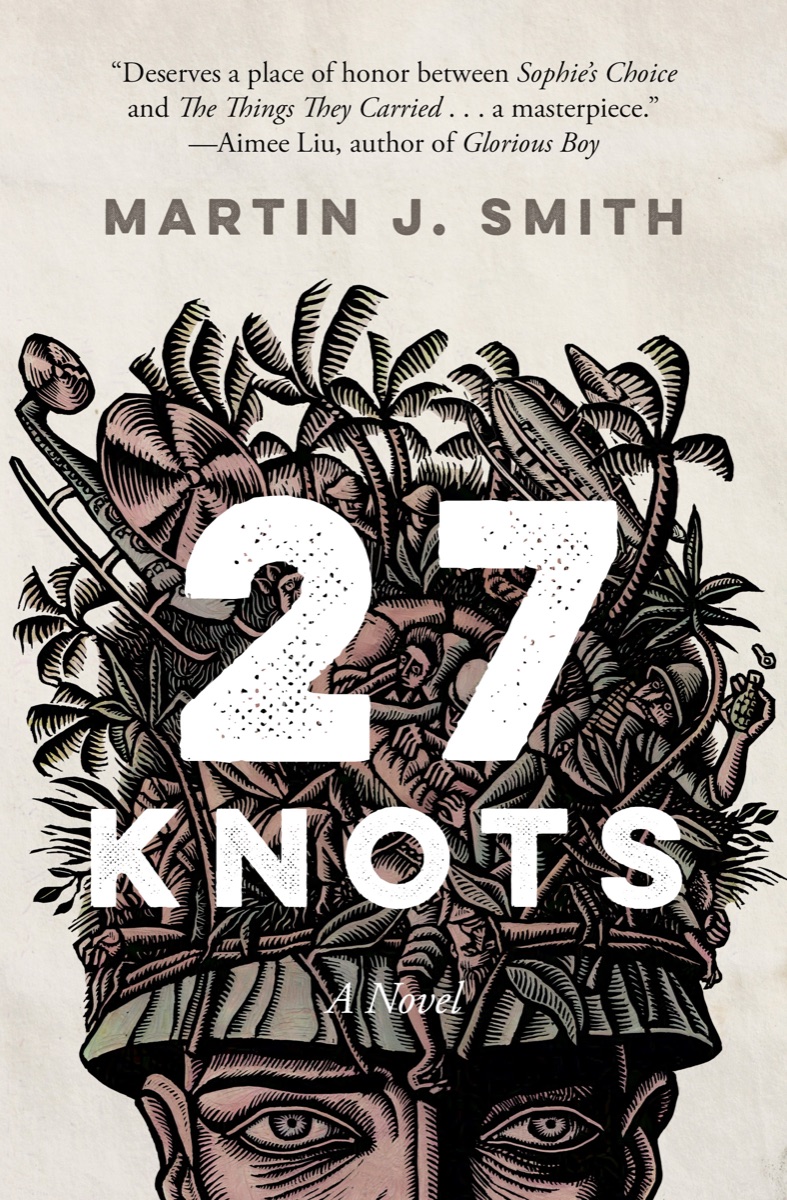
Author Q&A
27 Knots Q&A
Martin J. Smith talks about his most recent novel
You’ve said the idea for this novel began in a hospital waiting room in Palm Beach, Florida. Explain.
That was in 2022, during a visit with my older brother Bill, about whose Vietnam war experiences I knew very little at the time. In 2020 we lost both of our parents, a brother, and Bill’s wife. As the last two survivors of our immediate family — we’re 12 years apart — he and I resolved to spend more time together, so I was visiting him from my home in Colorado. Maybe it was because we were in a waiting room at the VA hospital there. More likely he was finally ready to share some of his stories after a half century of silence. But it was in that waiting room that we began to talk about his time in Vietnam.
So how’d that conversation begin?
Bill served on a napalm boat as part of the Navy’s Mobile Riverine Force in the Mekong Delta in 1969 and 1970. It had an eight-man crew, and before their tour was over four of the original crew members were dead. I asked if he’d kept in touch with the other three survivors, and his answer startled me. When they parted ways at Tan Son Nhut Air Base he said they vowed to never contact one another again. That intrigued me, because mental health experts would tell you the healthy way to deal with their kind of combat trauma is to share the experience with others who went through it. But they kept their vow, and never reached out. I began to wonder what secrets they shared that compelled them to walk away from one another and never look back.
But how did it become a book idea?
I’m a professional storyteller, so my mind immediately went to work. I asked: “What if three of those survivors finally got together after fifty years to bury the fourth? What might happen?” I think he was intrigued by the whole fictional scenario, and that scenario became the premise of the novel. After 50 years, Bill finally started to talk.
Do you think shifting the conversation from “What happened to you?” to an imaginary scenario felt safer for him?
I’m not a psychologist. All I know is what actually happened. That was the start of a conversation that lasted almost five years. But I started writing the novel as soon as I got home from that trip, and within two months I had 200 good pages. It felt like it was writing itself. I began sharing pages with Bill, and he kept talking, often calling me several times a week with more and more stories. He seemed very invested in the book at that point.
Was there a specific detail he shared in those early conversations that jumped out at you?
He told me a story he heard during his SERE training before the crew deployed together. That training was meant to teach the crew techniques for survival, evasion, resistance, and escape if they were ever captured. One crew member who endured the ordeal better than the others on the crew was pulled aside afterward and given a secret, unwritten, and apparently unlawful order: If a certain crew member is ever captured, it’s your job to be his “guardian.”
Meaning?
That crew member was assigned to prevent his crewmate’s capture at any cost.
Wait. What does “at any cost” mean?
Just what it sounds like. That might include sacrificing himself to prevent his crewmate’s capture, or even killing his captured crewmate before he could disclose sensitive information.
Yikes.
Yeah. There were strategic reasons for it. Those napalm boats were sitting ducks, and very vulnerable to rocket attacks. If someone ever told the enemy where to hit one with a rocket, you can imagine the result for the rest of the crew. So that secret assignment became the personal and moral dilemma I wanted to explore in the story, along with the long-term effects of putting that kind of burden on a 20-year-old kid.
The novel’s title must have something to do with nautical speed, right?
Actually, no. Those boats were basically barges, with a top speed of about 8.5 knots, or 10 miles per hour. That’s why those crews saw so many firefights. Running away was not an option.
So what then?
Talking to my brother and researching the role of military snipers led me into a fascinating subculture where I was struck by the unusual emphasis on social hierarchy and scorekeeping. The Vietnam War was notorious for scorekeeping, with daily body counts on the nightly news.
More on scorekeeping in a minute. But in terms of hierarchy, the system that evolved since my brother served separates snipers into two types — PIGs and HOGs. PIGs are Professionally Instructed Gunmen, who receive a lower level of training. I think that’s where my brother’s experience places him in that hierarchy. But there’s a more elite level of sniper called a HOG, a Hunter of Gunmen, who graduates from the Marine Corps Scout Sniper School. Those snipers are trained to stalk and hunt other snipers. When they graduate, they’re given a symbolic HOG’s Tooth necklace, a 7.26 bullet hung from a cord.
What does it symbolize?
That’s where we get into the scorekeeping thing. The most elite prize for a sniper who hunts other snipers is called a Hog’s Tooth. Imagine two patient professionals who have spent days or weeks stalking one another, waiting for the other to make a mistake. If you kill the other sniper, the ultimate prize is in the chamber of that dead sniper’s gun — the bullet that was meant for you. Those who can retrieve that bullet from their victim’s rifle get to wear it as a talisman. In my brother’s time, the scorekeeping was done in a different way. The warriors who were in the Mobile Riverine Force wore black berets. On the back of those berets were two tiny silk ribbons that hung down like rattails. In Bill’s time, the unofficial protocol was to tie a knot in one of those ribbons for each confirmed kill.
So, 27 Knots.
My brother no longer has his beret, so I honestly don’t know how many knots he tied in his. But I know that when I asked him about it, he gave me an exact number. And the fact that he knew it fifty years later makes me think those memories are still very much alive for him.
In the novel, the narrator, Vance Leford, pens a memoir for his wife of fifty years, Dahlia. Why is so she important in the book?
Their origin story sits at the very heart of the novel, and his fear of losing her by confessing the truth about his Vietnam experiences is Leford’s sole motivation for everything he does. Dahlia’s an off-screen presence throughout much of the book, but she’s his confessor. He’s clearly talking to her as he writes it all out. The story is basically a 325-page confession to the woman he loves.
The phrase “moral injury” crops up a couple times in the novel. What does that mean?
Moral injury is a form of post-traumatic stress disorder. Most warriors go into combat with a strong moral compass. They know right from wrong. But the world sometimes tilts when you’re at war. In some cases, they’re doing things — and occasionally rewarded for doing things — they know are wrong. I wanted the story to get at the long-term psychological costs of that, which is why it’s set fifty years after the Vietnam War.
Has writing this book affected your relationship with your brother?
I think it brought us closer, which is a huge benefit separate from the book itself. But I don’t pretend to have peeled more than a couple of layers of that onion. He’s more complicated than I’ll ever understand. But I love, admire, and profoundly respect him and his service during a difficult time in our country’s history, and that’s always been the case.